


Ara bil-
 Malti
The Calling of the Catechist Today
I would like to begin this reflection by extending to you the same invitation that Pope Leo XIV made during the Assembly of the Diocese of Rome a few weeks ago. Let us enter into the episode recounted in the Gospel according to St John: on the first day of the week, early in the morning, while it was still dark, in the garden where Jesus’ tomb was situated. There we find Mary Magdalene. She arrived very early, before the light had fully dawned. She had come in search of Jesus, but she did not find him. The tomb was empty. And Mary began to weep.
In the garden, at the dawn of Easter
The darkness in which Mary found herself was not simply the darkness of a night that had not yet come to an end. It was the darkness of someone who had lost a person she loved; of someone who is searching but cannot find; of someone who no longer knows what to do or where to turn. Jesus was the one who had changed her life, the one who had given her new hope, and now it seemed that everything had come to an end.
But the Gospel shows us that she did not remain alone in her sorrow. The Risen Jesus approaches her, although she does not recognise him. She thinks he is the gardener. And Jesus asks her two questions: “Why are you weeping? Whom are you looking for?” (Jn 20:15).
These are two simple questions, yet they are full of meaning. Today, I would like us to allow them to enter our hearts as catechists, concentrating especially on the second: “Whom are we seeking?”
For this is a question that goes straight to the heart of our vocation. When we think about our ministry as catechists, our minds easily turn to everything we do. We think of preparing lessons, programmes, meetings, books, activities, communication with children as well as with parents, and the many responsibilities we carry. All these things are important. But today Jesus is not asking us how many things we have done, how many lessons we have given, or how many children have passed through our hands. He is asking us something much more fundamental: Whom are we seeking?
Today, let us pause for a moment and recognise that, before we are catechists, we are disciples. Before teaching about Jesus, we are called to encounter him. Before leading children to Jesus, we ourselves must be people who seek him, listen to his voice and allow him to guide us.
It can happen that, without realising it, we become so busy doing things for Jesus that we no longer have time to be with Jesus – like Martha and Mary: one was busy working and striving for Jesus, while the other sat at his feet in his presence. We may be speaking about him without actually listening to him. We may be teaching children to pray, while perhaps our own prayer has become nothing more than a habit. We may be explaining the Gospel, while perhaps the Gospel no longer touches our hearts or challenges us.
Therefore, this question must be the starting point of our reflection: Whom are we seeking in our ministry? Are we seeking Jesus, or are we perhaps more concerned with carrying out the work expected of us in his service?
“Why are you weeping?” – The truth about the heart of the catechist
The first question Jesus asks Mary is: “Why are you weeping?” It is a question that reveals how deeply Jesus cares about the human heart. Before explaining what has happened, before telling her that he has risen from the dead, Jesus approaches her and gives her the opportunity to express what she is feeling.
Jesus does not ignore her suffering. He does not tell her to stop crying or that she should no longer be sad. He meets her precisely in the moment of her sorrow.
We can also turn Jesus’ question to Mary towards ourselves. What is my heart carrying? Perhaps there is a tiredness that has been building up for a long time. Perhaps there is disappointment because, after so many years of service, I do not see the fruits I had hoped for. Perhaps I feel that today’s children are very different from those of the past, that parents do not always support us, and that faith is no longer given the same importance within families.
Perhaps there are also sorrows that we do not speak about. We remember children who passed through our classes and received the sacraments, but who today have drifted away from the Church. We ask ourselves whether everything we did really made a difference. At times, we may feel that we are working very hard but seeing very few results.
Jesus does not ask us to hide these feelings. He does not ask us to pretend that everything is going well. He invites us to be honest before him, because a catechist who acknowledges his or her own weaknesses can become a more humane, more sensitive person, and someone better able to understand those entrusted to their care.
“Whom are you looking for?” – Before we teach, we must encounter Jesus
Let us return to the central question: “Whom are you looking for?” It is interesting that Jesus asks Mary this question precisely when she is searching for him. Mary is not an indifferent person. She is not someone who has forgotten Jesus. On the contrary, she went to the tomb because she loved him. But she had not yet understood that her relationship with Jesus needed to change. She could no longer seek Jesus as someone she had lost; she needed to encounter him as the Living One, the one who had conquered death.
This is an important invitation for us too. Perhaps we are seeking Jesus, but sometimes we look for him in things which, although good, are not at the centre of our vocation.
Perhaps we seek him in the success of our class, in the good behaviour of the children, in a lesson that has gone perfectly, or in the appreciation of parents. Perhaps we feel satisfied when someone acknowledges our work or when an activity we have organised proves successful. These are good things and they have their value, but they cannot take the place of Jesus.
The Pope reminds us that every pastoral initiative should begin not so much with the question, “What shall we do?”, but rather with the questions, “Whom do we want to encounter? How can we help others to encounter him?”
This represents an important shift in the way we understand catechesis. Catechesis is not simply the transmission of religious information. It is not merely about children learning prayers, the commandments, the history of salvation or the teaching of the Church. All these things are important and necessary – and we know how widespread religious ignorance is, even among adults; one only needs to look at the comments on social media. But the ultimate goal is for children to encounter a person: Jesus Christ.
It is not enough for a boy or girl to know who Jesus was. We must help them discover that Jesus is alive, that he loves them, knows them by name and wishes to be part of their lives. It is not enough for them to learn about prayer. We must help them discover that they can speak to God as to a Father who loves them. It is not enough for children to know what the Mass is. We must help them discover that in the Eucharist we encounter Jesus, who gives his life for us. But none of this can happen unless we ourselves are living this relationship.
Therefore, each one of us must ask whether we are making room for Jesus in our lives. Do we take time to be silent? Do we read the Gospel not merely to prepare a lesson, but to listen to what it is saying to us? Do we spend time before Jesus in the Eucharist and simply say to him, in the words of St George Preca: “Lord God, you are here and I am in you” (The Sanctuary of the Spirit of Christ)?
Perhaps we need to rediscover the joy of being in God’s presence without having to ask him for anything, without preparing something for others. Simply being with him. For we cannot give what we ourselves are not receiving. We cannot help children discover the joy of the Gospel if we ourselves are not allowing the Gospel to fill our lives.
“Mary!” – The joy of being known and called by name
In the Easter story there is a particularly beautiful and significant moment. Mary does not recognise Jesus. She sees him and speaks to him, but she still does not recognise who he is. Then Jesus says just one word: “Mary!” (Jn 20:16).
And at that moment everything changes. There is no lengthy speech or complicated explanation. Jesus simply calls her by name, and Mary recognises him.
Here we encounter a beautiful truth about our faith. We are not simply people who believe in a God who knows us in a general sense. We are people whom God knows personally, whom he loves and whom he calls by name. God does not see merely a crowd of people or a group of believers. He sees each one of us, with our own story, our joys, our wounds and our hopes.
This is an experience that we, as catechists, need to live. Perhaps many of us have been serving in catechesis for years. We have experience, we know the programmes and the classes, and we know how to prepare lessons. But we must never forget that our vocation is not simply the result of our own decision to do something good for others. It is a response to a calling.
God called each one of us by name. And perhaps today we need to remember once again why we said yes. It may be that someone encouraged us to become catechists. Perhaps we felt that we had something to give. It may be that we were going through a spiritual experience that moved us. Or perhaps we simply wanted to make a contribution to our community. But beyond all these reasons, there was God, who called us.
And if we are still here today, despite the tiredness we sometimes experience and the difficulties we encounter, it is important to remember that God is still calling us. He did not call us because we are perfect. Quite the contrary. He called Peter despite his weakness, Thomas despite his doubts, and Matthew despite his past. He did not call us because we know everything or because we always have the answers. He called us because he knows us, loves us and knows that, with the help of his grace, we can become instruments in his hands. What he asks of us is not perfection, but an open heart and a willingness always to seek him and continue walking in his footsteps.
I would like us to remember here a truly beautiful episode in the life of Jesus, when someone eagerly sought Jesus, only to discover that Jesus was seeking him – the story of Zacchaeus. He wanted to see Jesus, overcame the obstacle of the crowd, climbed a sycamore tree, and there he discovered that Jesus’ eyes were looking towards him. There he heard the invitation: “Zacchaeus, hurry and come down, for I must stay at your house today” (Lk 19:5). Jesus also called him by name, and their encounter brought about a complete transformation.
From people who encounter Christ to people who build community
When Mary Magdalene recognises Jesus, she does not remain standing beside the tomb. She goes to the disciples and announces to them: “I have seen the Lord!” (Jn 20:18).
Her encounter with Jesus does not remain a private experience. It becomes a mission, a witness and Good News for others. Mary understands that she cannot keep what she has experienced to herself. She must share her joy.
This tells us something fundamental about catechesis. We cannot be satisfied simply with delivering our lesson, closing the book and sending the children home. The question is not merely whether the children have learnt something today, but whether they are growing as living members of the Christian community.
Catechesis should lead to an experience of the Church: a community in which every person feels welcomed, accompanied, appreciated and responsible.
The Pope reminds us of the need to create communities that are not simply groups of people who meet to carry out an activity, but places where genuine relationships are built. This also applies to our catechetical classes. A catechetical class should not simply be a group of children who meet regularly. It should be a small community in which they learn to listen to one another, forgive, share, pray and care for one another. It should be an experience in which every boy and girl feels that they have a place, that they matter and that they can contribute.
This requires us sometimes to change our perspective. Instead of focusing only on how to maintain control of the class, we should begin to think about how we can create an environment in which children feel that they belong to a community. Instead of worrying only about whether we have completed what we planned, we should ask whether we have helped the children grow in faith. Instead of seeing children who do not participate as a problem, we should try to understand how we can help them find their place.
We must also remember that catechesis cannot remain confined within the walls of the room where we meet. Children live in families, in a social environment and in a world that is constantly changing. Some of them live in families where faith is part of everyday life, while others come from families in which their parents have a more distant relationship with the Church. Some children carry with them family difficulties, loneliness, a lack of attention or a lack of security.
We cannot ignore this reality. We must learn to listen, understand and accompany. A catechist is not someone who has all the answers, but someone who walks alongside children and helps them discover how the Gospel can shed light on their lives.
And this mission cannot be ours alone. We need families, the parish community, priests, other catechists and all those who have responsibility for the Christian upbringing of children. Faith cannot be lived as an isolated experience. It needs a community that gives it life and helps it grow.
It is within a community that we can better understand the children themselves. We may see a boy who pays no attention, a girl who does not participate, a young person who appears indifferent, or parents who do not cooperate, and we may quickly reach conclusions about them. But how often do we stop and ask ourselves what might lie behind their behaviour? What are they carrying within them? What is hurting them? What are they seeking? What are they lacking?
It is possible that a child who appears uninterested is experiencing a difficult family situation. Perhaps a girl who does not speak simply needs someone to give her a little attention. Perhaps a young person who displays indifference is asking profound questions about life but does not know with whom to share them. The catechist is called to see beyond what is visible on the surface. The catechist is called to have a heart that knows how to listen, that does not judge too quickly and that tries to understand.
But there is something else we must learn when building community. Just as Jesus called Mary by name, so too we must be able to recognise and call children by their names. Think for a moment about the children who come to you. How important it is for children to meet catechists who see them, recognise them and give them the importance they deserve. A boy who feels known begins to feel that he has a place. A girl who feels that someone is listening to her may begin to open her heart. A young person who feels that someone believes in him may begin to believe in himself again, and perhaps even in God.
The first catechesis we offer is not found in the content of what we say, but in the way we encounter children through our presence – where the way we welcome them, listen to them and make them feel valued becomes, for them, an experience of God’s love.
The question “Why?” – Evaluating our catechesis
In his address, the Pope emphasises the need for the Church to learn to evaluate what it is doing. Not in order to criticise herself unnecessarily, not to add more work, and not to create further initiatives. Rather, it is about pausing, looking at reality and asking what is bearing fruit, what needs to change and what can better serve her mission.
I believe this is a particularly important invitation for us catechists. Sometimes we become so accustomed to doing the same things that we do not even stop to ask ourselves why we are doing them. We retain certain methods because that is how we were taught. We repeat activities because we have always done them. We continue working in the same way because we have become accustomed to it; that is simply how things have always been done. But the question is whether these things are still helping our children encounter Jesus today.
The Pope invites us to ask: “Why?” Why are we organising this activity? Why are we choosing this method? Why do some children feel close to the Church while others are drifting away? Why do some children eagerly look forward to their catechetical meeting while others attend only because their parents want them to? Why do some children continue participating in parish life after receiving the sacraments, while so many others never return?
These are not questions that should make us feel guilty. They are questions that help us see reality more clearly and can help us grow and become more aware of our mission.
In this evaluation, the first thing we should reflect upon is whether our catechesis is truly helping children encounter Jesus. Perhaps at times we become so focused on the content we want to communicate that we forget the heart of the message. The second consideration is whether we are building relationships and communities: whether children feel welcomed and whether they can express their doubts without being afraid of being judged. The third is whether catechesis is helping them live their faith in everyday life: in the way they treat one another, in their families, at school and in society. And, naturally, we must always ask whether we ourselves are continuing to grow as disciples and witnesses.
For the true fruit of catechesis is faith that grows, a heart that changes, a relationship with Jesus that becomes stronger, and a life that becomes more evangelical.
Nevertheless, we must remember that these fruits are not always visible immediately. Sometimes we are the ones who see the results of our work, but at other times someone comes after us and reaps what we have sown. When we truly seek Jesus, we learn from him that our work in catechesis is like that of someone who sows seeds. The seed does not always fall on good soil – sometimes it falls along the path, on rocky ground or among thorns (cf. Mt 13:4–8). We sow, but it is God who gives the growth. Therefore, we must not lose heart if we do not immediately see the fruits we desire. Our mission is to remain faithful, to work with love and to allow God to do his work.
We are not simply seeking to do more, but to do better
There is another point from Pope Leo XIV’s address that I would like to emphasise. He reminds us that pastoral evaluation should not become another burden on the shoulders of those who are already working. On the contrary, it should help us, where necessary, to do less, but to do it better.
This is something we need to hear as catechists, because we know how demanding our ministry can be. Preparing lessons, attending meetings, organising activities, communicating with parents, providing formation and responding to the different needs of children. Sometimes we feel that it is never enough and that there is always something else we need to do.
But Jesus is not asking us to be superheroes. He is not asking us to do everything or to keep looking for ways to do more. He is asking us to be faithful witnesses to his love. We must not forget that everything does not depend on us. We must not feel that we have to solve every problem, answer every question and control every situation. We must learn to trust in God, work together and share responsibilities.
An individual catechist can do a great deal of good, but a community of catechists who pray together, learn together and support one another can become a much more powerful witness.
Therefore, we should not be afraid to ask for help, to admit that there are things we do not know, or to change methods that are no longer bearing fruit. Nor should we forget that catechists need to be accompanied, encouraged and formed. Those who teach must continue learning. Those who give must also receive.
“I have seen the Lord!” – Catechists as witnesses
Let us return to Mary Magdalene. After Jesus calls her by name, she recognises him and goes to announce to the disciples: “I have seen the Lord!” This phrase is brief, but it contains the very heart of the Christian mission. Mary does not simply say that she has heard about Jesus or that she has learnt something new about him. She says that she has encountered him. She has experienced his presence. And this experience has filled her heart so deeply that she cannot remain silent.
Here lies the difference between someone who simply communicates a teaching and someone who gives witness. A catechist is not expected to be perfect. Nor is a catechist expected to have a life without problems. But a catechist should be someone who can say, with complete honesty, that he or she has encountered the Lord, that he is at the centre of his or her life, and that he or she is still learning to follow him.
Our children need to see this. They need to see catechists who pray not merely to begin a lesson, but because they believe in prayer. Catechists who forgive and ask for forgiveness, who show respect and who love. Catechists who do not merely speak about God’s compassion, but demonstrate it in the way they treat others. Catechists who do not simply speak about the joy of Easter, but manifest that joy and try to be signs of hope even in difficult moments.
This does not mean that we should hide our weaknesses or pretend that we have all the solutions. On the contrary, sometimes our witness becomes more authentic when children see that we too struggle, that we sometimes make mistakes, but that we always turn back to Jesus, who welcomes us because he loves us. For, ultimately, children may forget many of our words, but they will find it difficult to forget someone whose love helped them feel that God loves them.
Catechists are called, through the witness of their lives, to say: “I have seen the Lord!” And through this witness they help others discover that Jesus is alive, that he is close to them and that he is calling them too.
A personal commitment: Whom are we seeking?
I would like to conclude this reflection by returning to the garden where Mary Magdalene is standing. I invite you to imagine the Risen Jesus before you. He has not come to judge us. He has not come to ask how many activities we have organised or how efficient we have been in our work. He has come to meet us, to listen to our hearts and to call us once again by name. And he asks us too: “Whom are you looking for?”
Today, we must answer him with complete honesty: sometimes we seek success in our work more than we seek him. Sometimes we seek the appreciation of others more than his presence. Sometimes we struggle to teach children, but forget that we too need to learn from him. Sometimes we become so preoccupied with what we have to do that we forget why he called us in the first place. But today we have the opportunity to return to the source of our vocation. We can tell him that we want to continue seeking him, that we want to encounter him once again, that we want to listen to his voice and allow him to call us by name. We want to be catechists who help those entrusted to our care discover that Jesus is calling them too.
My hope is that we will leave this reflection not with the idea that we have many more things to do, but with hearts more open to Jesus and with a renewed desire to follow him.
Our mission is to help others find Jesus, recognise that he loves them and learn to follow him. But this can happen only if we ourselves continue to seek him every day. For before we are catechists, we must remain disciples. Before we lead others to Christ, we ourselves must be people who encounter him.
✠ Joseph Galea-Curmi
Auxiliary Bishop
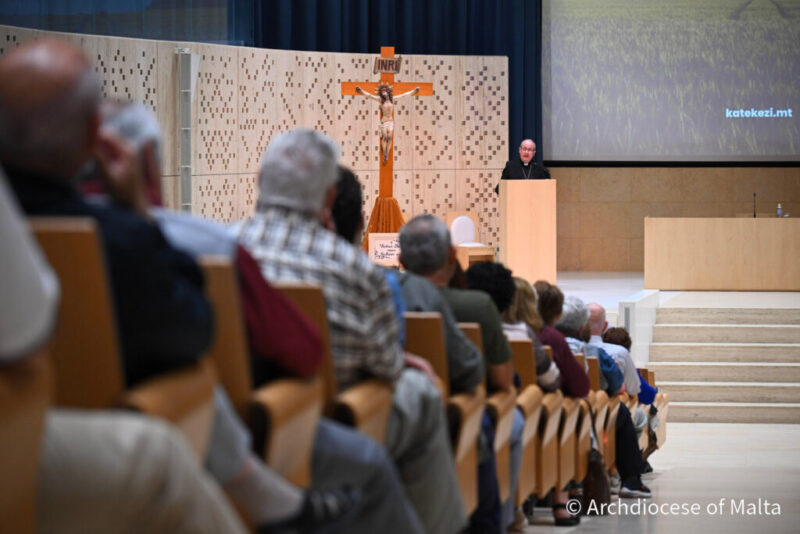
Meeting for Catechists – 18 November 2026
MUSEUM Auditorium, Blata l-Bajda
Translation from the original Maltese